

A recent Twitter thread from Matt Martin (@missingwords) of the Lucasfilm Story Group – the collective of creative minds that help to shape and maintain the continuity for the entirety of the Star Wars saga – has apparently ruffled some feathers within the Star Wars fandom. The thread states, amongst other things, that “It’s all fake anyway so you can choose to accept whatever you want as part of the story.“
For the sake of clarity, “canon”, as it relates to Star Wars, is a term that describes all of the characters, species, objects, planets, histories, and story lines that are officially recognized by Lucasfilm as being included as a part of the fictional universe of Star Wars as originally created by George Lucas. This includes stories and descriptions from the films, television series, games, novels, comics, et al. that form the foundations of the Star Wars mythos. The Lucasfilm Story Group is a group of individuals within Lucasfilm Ltd. whose responsibility it is to keep track of the current state of this canon in order to provide assistance to writers, directors, actors, and other licensed content creators in the development of new stories.
Many fans appear to be taking Mr. Martin’s comments as a sort of dismissal of the rich lore and history that was originally created by George Lucas and introduced to the world back on May 25, 1977, and the ongoing stories that were birthed from his cinematic masterpiece. It seems that these fans have taken this thread as a personal affront to their own understanding and sensibilities in regards to the galaxy far, far away. They are drawing parallels between the things said by Mr. Martin and the “de-canonization” of the stories from the old Expanded Universe – now labeled “Legends” – when Disney purchased Lucasfilm back in 2012. (I encourage you to read the rest of the thread for a bit of perspective on the topic.)
The truth of the matter, however, is at once much simpler and more complex. It’s clear that the Lucasfilm Story Group is drawing on a number of different sources to continually expand the epic drama that is Star Wars, including stories that had been considered Legends. Imperial Grand Admiral Mitth’raw’nuruodo (Thrawn) and Captain Gilad Pellaeon have been returned to formal canon status through a combination of the “Thrawn” series of novels and the animated television show, “Star Wars Rebels“. Planets (and their EU names) like Malachor, Taris, and even Korriban are once again a part of the galactic landscape and history through various forms of media. Even a perennial fan favorite character, Revan – who many fans have been asking to see brought to life in a film or TV series – has been reinstated as a historical figure in the existing canon (albeit, through a somewhat vague and tangential note in the reference book, “Star Wars: The Rise of Skywalker – The Visual Dictionary” regarding the legions of Sith Troopers). Piece by piece, what has, for the past few years, been considered Legends is once again becoming a fully recognized part of Star Wars lore.
What the heck is thIS “Expanded Universe”, anyway?
The Expanded Universe (or “EU“) encompasses all of the licensed material that was produced for Star Wars prior to April 25, 2014 other than that which George Lucas either directly created (the films) or had a personal involvement in creating/publishing (e.g., “The Clone Wars“). This includes virtually all novels, comics, games, toys, spin-off movies, television shows, and other forms of media. The EU’s inception technically stems from a story titled “The Keeper’s World” published in Marvel Comics’ Pizzazz magazine in October of 1977, although many fans cite the novel “Splinter of the Mind’s Eye” by Alan Dean Foster as the genesis for extra-cinematic storytelling for Star Wars. The sheer volume of characters, alien species, factions, vehicles, weapons, organizations, and even entire worlds that were brought to life by other creators between 1977 and 2014 is simply staggering.
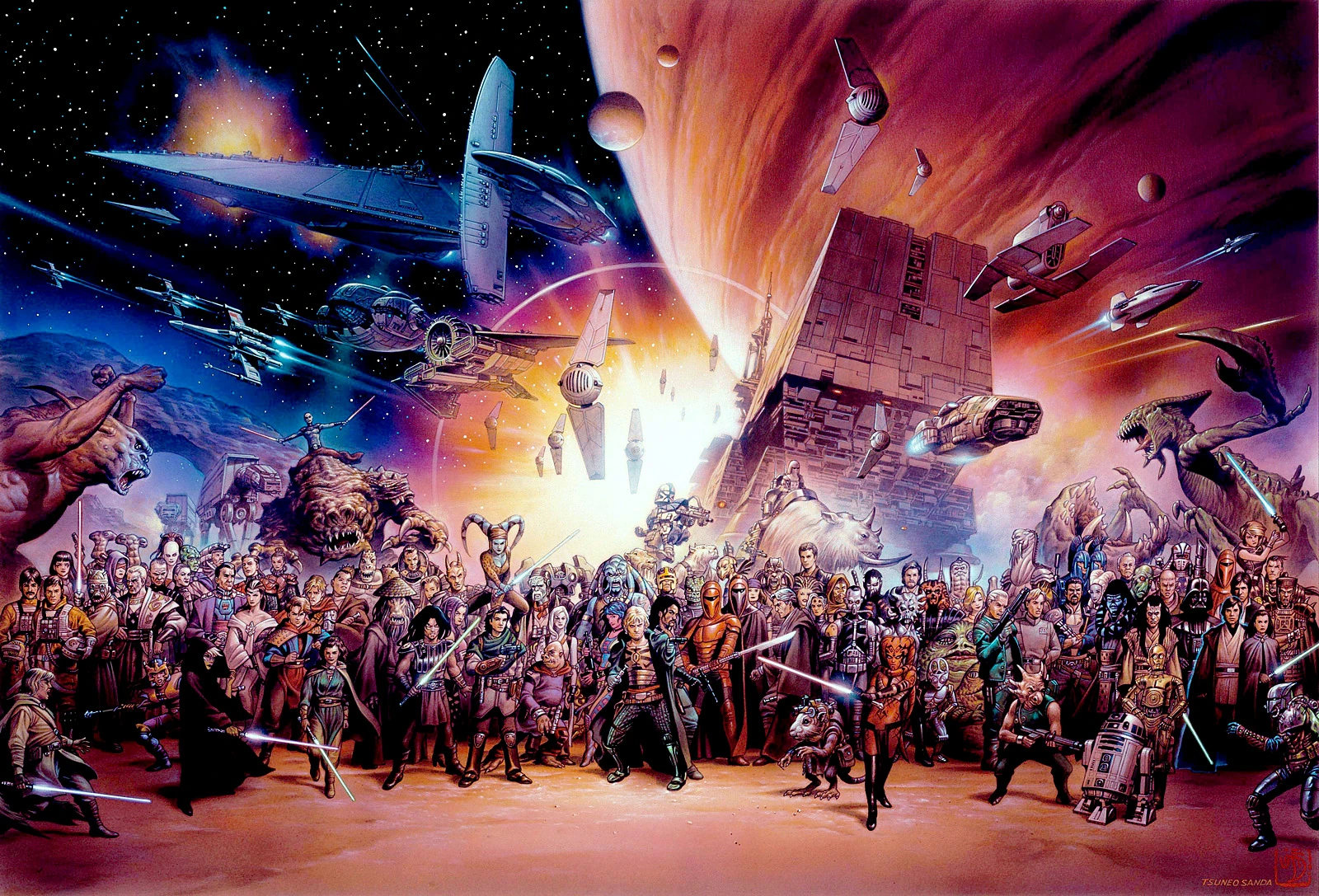
But, let’s be completely honest here. The old Expanded Universe, while producing some absolutely fantastic stories and undeniably fascinating characters, was something of a mess at the time. To start with, everything produced for Star Wars from that time was fit into one of six different tiers, or “levels”, of canonicity. The films were considered “G-Canon” (or George Lucas canon), along with anything that could be directly attributed to an origination from “The Maker”, including production notes, movie novelizations, source books, etc. Below this tier, in descending hierarchical order, came the “T-Canon” (television shows – specifically “The Clone Wars“, as this was the only TV series in production at the time), “C-Canon” (continuity stories such as novels, comics, games, cartoons, etc.), “S-Canon” (secondary materials from before Star Wars canon was a “thing” that could be used or dismissed by Star Wars creatives), “D-Canon” (stories from the cancelled animated show, “Star Wars: Detours“), and, finally, “N-Canon” (non-canon stories that could not be reconciled with the higher levels of canonicity). As confusing as all of this tiering of the stories could be for fans, I can only imagine how difficult it was for those who were trying to maintain any sort of consistency in the Star Wars universe.
So, what’s the problem with the new canon?
From a fan perspective, my interpretation is that some are upset with the way that Lucasfilm has handled Force abilities since the Disney acquisition. The depiction of certain talents such as Luke Skywalker’s astral projection during the Battle of Crait, the healing touch of Rey in “The Rise of Skywalker” (and also “The Child” from “The Mandalorian“), as well as the psychometry (knowing the history of an object by simply touching it) exhibited by Cal Kestis in the game, “Jedi: Fallen Order” have been decried as a form of Deus ex machina for the Star Wars saga. Some claim that this represents a form of “power creep” when it comes to Force users, where storytellers are forced to continually come up with more and more outlandish and awe-inspiring abilities to keep fans interested.
However, each of the above examples actually has existing precedent in Star Wars lore, albeit usually from a now-Legends source. The astral projection – or Doppelgänger – ability used by Luke in “The Last Jedi” can be found employed by several Force users (including Luke himself) in EU sources including the “Legacy of the Force” and “Fate of the Jedi” series of novels (by various authors), as well as games such as “Star Wars: Knights of the Old Republic II – The Sith Lords” and the “Jedi Knight” series. Force healing is likewise mentioned in various novels such as the books of the Darth Bane trilogy of novels by Drew Karpyshyn, and other media. The same goes for Force psychometry. These abilities are not new to Star Wars since Disney’s purchase. They were introduced by authors of Expanded Universe material before the “canon reboot” and have simply found their way into new stories.

The other side of that coin is, obviously, what has been “removed” or “lost” from Star Wars since the EU was recategorized as “Legends”. Many fans feel like those EU stories were as “official” a part of the Star Wars narrative as the films themselves and the act of “wiping-the-slate-clean” in 2014 somehow showed a complete disrespect and disregard for all of that content that George Lucas had had a hand in creating.
In response to that, even George Lucas and Lucasfilm were “on the fence” when it came to the stories of the EU. For example, in an interview he gave with Starlog magazine in 2005, Lucas had this to say:
STARLOG: “The Star Wars Universe is so large and diverse. Do you ever find yourself confused by the subsidiary material that’s in the novels, comics, and other offshoots?”
LUCAS: “I don’t read that stuff. I haven’t read any of the novels. I don’t know anything about that world. That’s a different world than my world. But I do try to keep it consistent. The way I do it now is they have a Star Wars Encyclopedia. So if I come up with a name or something else, I look it up and see if it has already been used. When I said [other people] could make their own Star Wars stories, we decided that, like Star Trek, we would have two universes: My universe and then this other one. They try to make their universe as consistent with mine as possible, but obviously they get enthusiastic and want to go off in other directions.“
Starlog Magaine #337
While, in the introduction to the 1994 re-print of “Splinter of the Mind’s Eye“, he provided the following quote:
“After Star Wars was released, it became apparent that my story—however many films it took to tell—was only one of thousands that could be told about the characters who inhabit its galaxy. But these were not stories I was destined to tell. Instead they would spring from the imagination of other writers, inspired by the glimpse of a galaxy that Star Wars provided. Today it is an amazing, if unexpected, legacy of Star Wars that so many gifted writers are contributing new stories to the Saga.“
George Lucas – Introduction to “Splinter of the Mind’s Eye” by Alan Dean Foster (1994)
More recently, Pablo Hidalgo, also a part of the Lucasfilm Story Group provided this response when asked about the Expanded Universe:

Even so, as I outlined above (and I’ll comment on later), licensed Star Wars content creators these days are frequently drawing inspiration from Legends characters and stories, and, in some cases, bringing them back (with varying degrees of alterations) wholesale. If your favorite thing from the EU isn’t considered canon right now, it may simply be a matter of time before you see it recanonized and revitalized as a part of the ever-growing saga that is Star Wars.
HOW DOES all THIS RELATE TO MR. MARTIN’S TWITTER THREAD?
Okay, so I’ve gone on and on about Star Wars history and definitions, but why is this so important? I wanted to set the stage here because, as passionate as I am about Star Wars and as much as I personally geek out over what is and isn’t “official canon”, Mr. Martin’s statement doesn’t really have any impact on anyone’s enjoyment of George Lucas’ creation. I fully admit that I am a “canon-junkie”. I get genuinely excited when certain characters, items, or stories are “officially canonized” by the Lucasfilm Story Group. I spend hours reading detailed articles about random background characters to learn their history. But, that doesn’t stop me from continuing to enjoy those things of the EU that are still and may always be considered Legends. My personal opinion is that those stories continue to exist in something of an alternate reality to the current canon – a parallel universe in which Mara Jade, Bastilla Shan, and others will forever remain a part of galactic history.
The thing about Star Wars fandom – and, truly, any fandom – is that it’s personal. You and I are allowed to enjoy it however we want. We’re given a basic “framework” from which our imaginations can take us in any of an infinite number of directions. When we were kids playing make-believe, we didn’t care about whether or not what we did was an accurate representation of Teräs Käsi. We just wanted to be a part of that galaxy. As we get older, we can delve as deeply into the heart of the galaxy as we wish without being bogged down by minutiae, we can choose to pore over every Wookieepedia article out there for morsels of “facts”, or anywhere in between. If we want to ignore parts of the story in favor of our own “headcanon” (back stories we create for ourselves), we’re totally free to do that. We, as fans, are not beholden to what is and is not official canon. Or, to put it another way, as stated by Leland Chee (@HolocronKeeper) of the Lucasfilm Story Group:
When all is said and done, what is considered “official canon” is in a perpetual state of motion as new stories are added and old stories are expanded. Since the intellectual property that is Star Wars is owned by Lucasfilm/Disney, what is or isn’t considered “official” is ultimately up to them. But, as fans, we can take or leave the “new”, the “old”, or anything in between. I’m personally excited about what the future holds for this beloved franchise. Others are a bit more cautious or trepidatious. In the end, though, Star Wars is whatever you want it to be. To again quote the “Keeper of the Holocron“:
 As One In The Force